

The Spiritual Legacy of Tibetan Dzi Beads
A Millennium of Resonating Energy Across Time
(By UNIRELIC )
“There are materials in this world that seem to be blessed by time itself.
The Dzi bead is one of them.”
Origins · From Ancient Civilizations to the Snowy Plateau
In the high plateaus of Tibet and the Silk Road valleys, the Dzi bead was born — a relic whispered to have fallen from the heavens.
Archaeologists have unearthed ancient agate beads in Tibet, Nepal, Bhutan, and northern India, some dating back more than three thousand years.
Long before Tibetan Buddhism took form, these stones were revered by the Bon shamans as “the eyes of heaven.”
Crafted from agate and chalcedony, each bead was etched with fire and mineral solution — a ritual process where every mark carried meaning.
Fire symbolized purification, water the eternal cycle, and stone the permanence of matter.
Together they formed a vessel believed to store the vibrations of the universe itself.
When Buddhism reached the Tibetan plateau in the 7th century, the Dzi became more than a charm.
It evolved into a symbol of karma, enlightenment, and continuity.
Many high lamas were said to have their sacred relics sealed within Dzi beads, allowing their spiritual essence to remain in the world as a silent guardian.

The Hidden Language of Patterns
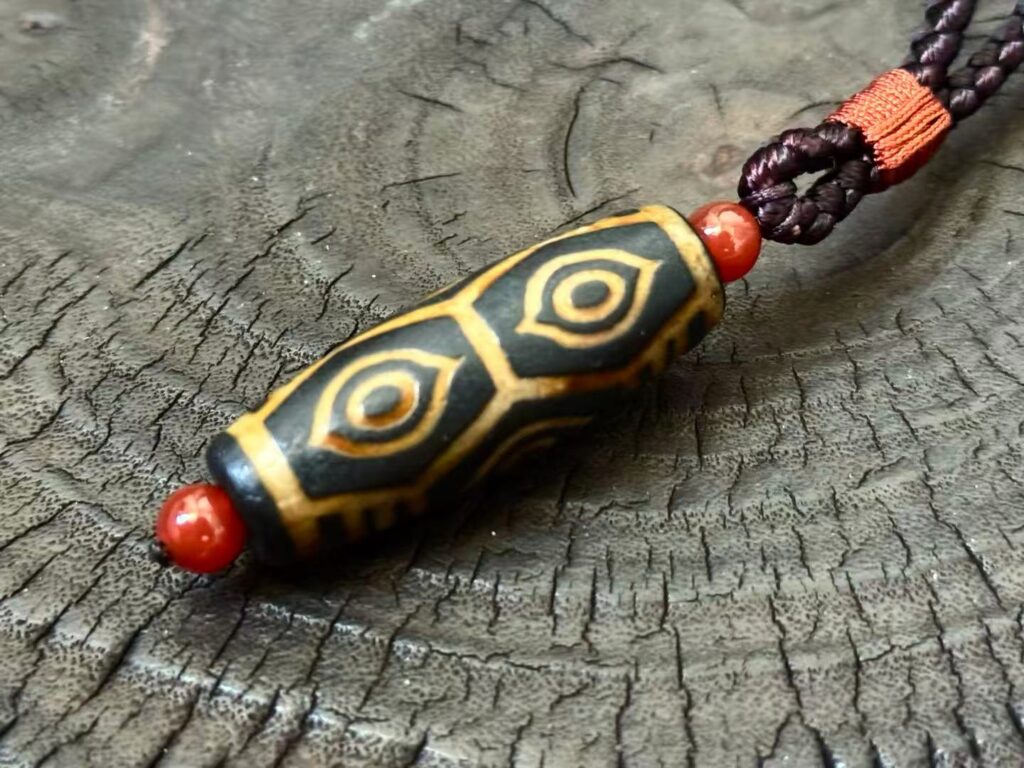
Each Dzi bears markings — eyes, waves, lotus forms, vajras, heaven and earth lines — known collectively as celestial patterns.
They were never made for ornamentation alone, but as symbols of alignment between human and cosmic energies.
Ancient artisans carved these designs through cycles of acid and flame, believing every etching was a sacred invocation.
The meanings endure across generations:
A one-eyed Dzi grants clarity and awareness.
A two-eyed Dzi unites yin and yang, harmonizing love and partnership.
A three-eyed Dzi invites wealth, health, and wisdom.
And the nine-eyed Dzi, the most revered of all, embodies completeness — the nine layers of universal energy, the cycle of destiny itself.
The “eyes” do not look outward; they look within — portals of perception leading the soul toward higher awareness.
Resonance · When Science Meets the Sacred
For centuries, Tibetans have said that Dzis are alive — and perhaps, in a subtle way, they are.
Agate, the stone from which most Dzi beads are carved, is rich in silica crystals that exhibit piezoelectric resonance.
This means it can store and release microcurrents of energy, interacting gently with the human biofield.
Those who wear true Dzis often describe a warmth in the palm or a quiet stillness of mind.
In modern energy studies, this is viewed as resonance between human and mineral frequencies —
a poetic affirmation that what the ancients called “spirit” may simply be nature’s vibration in another language.
The Vessel of Karma and Blessings
In the tradition of Tibetan Buddhism, Dzi beads are seen as celestial blessings — gifts from heaven imbued with protection.
They are placed upon altars, threaded into malas, or carried by monks during meditation.
Through centuries of chanting, prayer, and devotion, they become containers of accumulated vibration, infused with sacred intention.
An authentic old Dzi carries not only the marks of time but the weight of countless prayers.
Its worn surface, softened by generations of touch, holds invisible layers of energy —
each fingerprint a testimony of faith, each scar a silent hymn of protection.
The Modern Reawakening
Today, Dzi beads have crossed all cultural and religious boundaries.
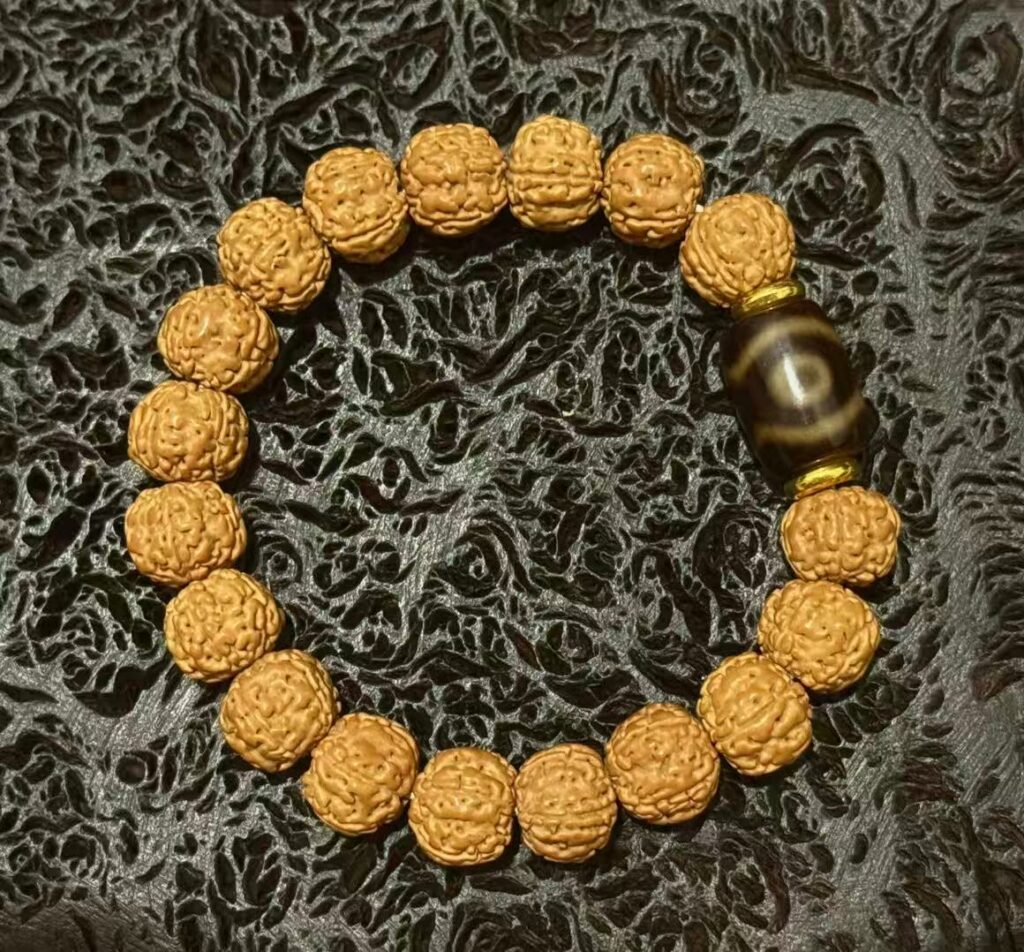
Designers reinterpret them into contemporary jewelry, while collectors and meditators cherish them as relics of resonance.
Some call them records of cosmic frequency; others, fossils of consciousness and time.
Their mystery, however, is not what makes them powerful.
It is the connection they awaken — that gentle reminder of how human life vibrates within the vast rhythm of the universe.
Each bead, like a crystallized prayer, hums quietly to those who can listen.
The existence of the Dzi itself is a metaphor.
It reminds us that energy never fades, and faith leaves form.
When you trace its ancient patterns, you are not merely touching stone —
you are touching time, vibration, and the quiet echo of the cosmos.